LED video wall for a home theater: the screen that replaces the projector
A projector needs a dark room and a bulb that is always on its way out. A direct-view LED wall makes its own light, so the picture holds with the lights up for the game and goes properly dark for the film.
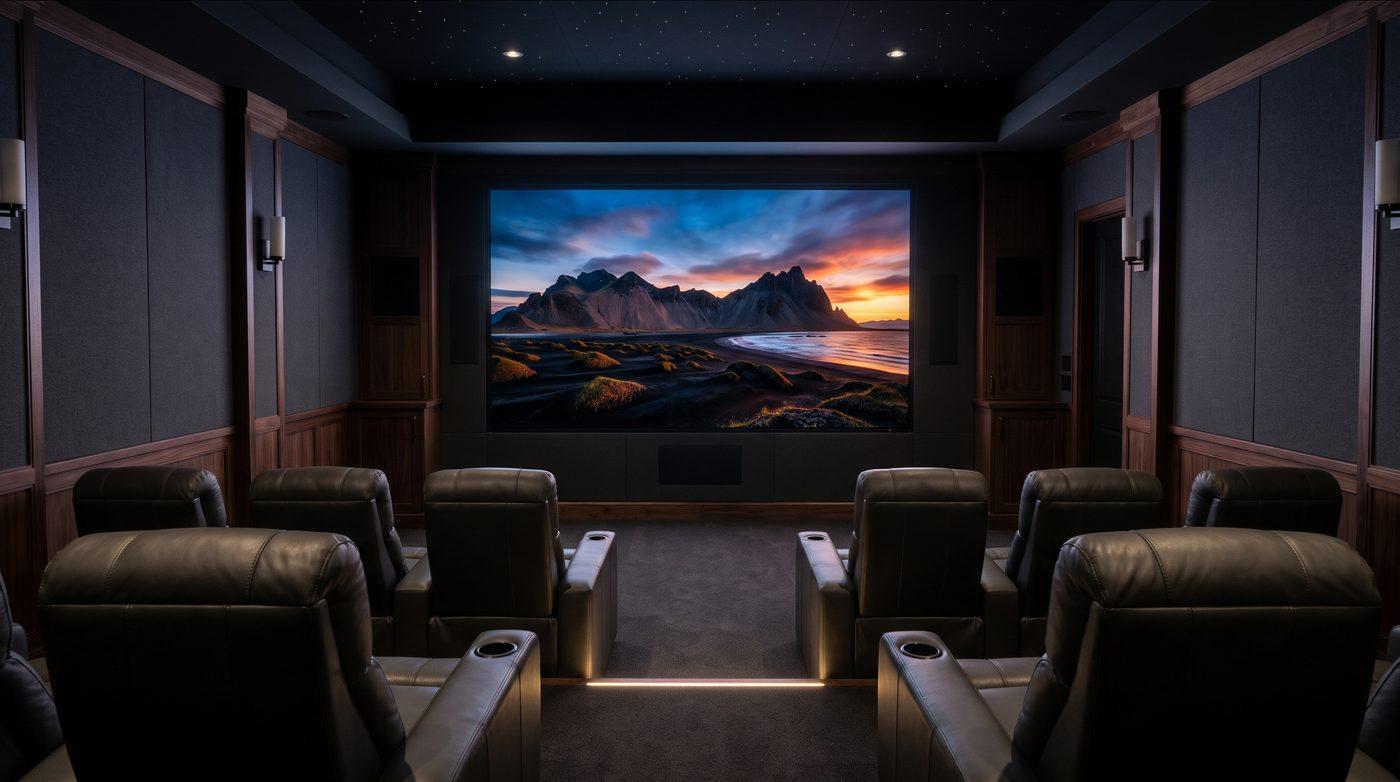
Past about 100 inches, a television stops being an option and the choice comes down to a projector or a direct-view LED wall. The projector asks for a dark room, a throw path, and a screen that washes out the moment someone turns on a lamp. The LED wall is the screen and the light source in one surface. It is bright enough for a Sunday afternoon game with the shades open, and it dims down for a film at night without the black level turning gray.
The UF Series is the home theater wall. Its flip-chip COB face is sealed and matte, so there is no lamp grid to see from the front row and nothing fragile at hand height in a room with kids in it. Pitch follows the seating: P1.25 suits a front row around eight to ten feet back, and P0.9 or finer is for rows that sit closer. Size is arithmetic from there. A true 4K picture is about 12 feet wide at P0.94 and about 16 feet wide at P1.25, and a wall can also be built to the exact opening in the millwork rather than to a catalog diagonal.
Film is the hard test for an LED wall, because most of a movie lives in the dark end of the picture where ordinary LED driving loses detail. Contrast ratio is peak brightness divided by the dimmest level the wall can show above black, so the way to raise it is to make that first step smaller. For rooms built around film we spec the wall on NovaStar's Infinity platform, which controls each pixel by current as well as by pulse width. The first step out of black gets far finer, shadow detail and gradients hold at low brightness, and the result is the deep, clean black people know from OLED, at a size no OLED is made in.
The same platform handles the source side. It takes 10 and 12 bit signals, including HDR10 and HLG, from a 4K disc player, a movie server, or a gaming PC over DisplayPort, and it switches between BT.709, DCI-P3, and BT.2020 color with a 3D LUT calibration loaded for the room. The wall follows the frame rate of the source, from 24 frame film to high frame rate gaming, while the panel itself refreshes thousands of times a second, so there is no flicker to see and nothing for your eyes to work against over a long film.
An LED wall is solid, so the center speaker sits above, below, or beside it instead of behind the screen, and we plan that with your integrator or audio designer before the wall is framed. We size the wall with you, confirm it on a site survey, and our own crew from 4Life Entertainment installs and commissions it with a full pixel-map test. Power and structure stay with your electrician and contractor. We work with homeowners, builders, and custom integrators across the NYC Metro area, New England, and nationwide.
The theater does not have to be indoors. For a pool deck, patio, or backyard, the AS Series is a sealed, weatherproof outdoor wall that stays readable in direct sun, which is the one place a projector cannot follow at all.

Home theater walls are specified on the NovaStar Infinity platform, which controls each pixel by current as well as pulse width for cleaner blacks and shadow detail.
How it goes
Wall opening, seating distances, and how the room gets used: film, sports, gaming, or all three.
Screen size and pixel pitch set from the front row, with speaker and equipment locations planned alongside.
Our crew mounts, wires, and levels the wall, with power and structure by your electrician and contractor.
Pixel-map test, picture calibration in the finished room, and a walkthrough of the controls before we leave.
Questions we get
Is an LED wall better than a projector for a home theater?
In a room that is ever used with lights on, yes. An LED wall makes its own light, so the picture holds in daylight and there is no bulb, throw distance, or screen to wash out. A projector still costs less at the same size, and it allows speakers behind an acoustically transparent screen.
What size LED wall fits a home theater?
Most home theaters land between the 108 inch and 216 inch class. Because the wall is modular, it can also be built to the exact opening, including wider cinema aspect ratios.
What pixel pitch does a home theater need?
It follows the front row. Around eight to ten feet back, P1.25 reads as a clean picture. Closer seating calls for P0.9 or finer. We set it from your seating plan and confirm it at the survey.
Can it show true 4K?
Yes, once the wall is wide enough for its pitch. A 4K picture is about 12 feet wide at P0.94 and about 16 feet wide at P1.25. Smaller walls are scaled from the 4K source by the processor.
Does it support HDR?
Yes. Walls built on the NovaStar Infinity platform accept HDR10 and HLG sources and hold shadow detail at low brightness, which is where film content is hardest on an LED wall.
How does an LED wall compare to OLED?
OLED sets the standard for black level, but it tops out at television sizes. A fine-pitch LED wall on current-controlled driving gets into the same territory for black and shadow detail, runs much brighter, and can be built at any size or shape.
What is the difference between refresh rate and frame rate?
Frame rate is how many pictures per second the source sends, usually 24 for film and 60 for sports and streaming. Refresh rate is how often the LEDs themselves redraw, typically 3,840 or 7,680 times per second. A high refresh rate is what keeps the picture free of flicker and scan lines, to the eye and on a phone camera.
Can an LED wall go outdoors by a pool or patio?
Yes. Outdoor walls are a different build: sealed, weatherproof cabinets with far higher brightness for daylight. We size brightness and pitch to the viewing distance and the sun exposure.
Where do the speakers go?
Above, below, or beside the wall. An LED wall is a solid surface, so the center channel cannot sit behind it the way it does with a perforated projection screen. We plan speaker positions with your integrator before the wall is framed.
Do you work with home theater integrators and builders?
Yes. We supply and commission the wall, and we coordinate drawings, power, and control with the integrator, builder, or designer running the room.
How much, and how soon?
Tell us how many, where it is going, and when you need it. We come back with a package price and a delivery date.