LED video wall installation, by the crew that builds them for a living
The panels are the easy part. A wall looks right for ten years because of what happens around them: a flat frame, clean power, tidy data, and someone who tests every pixel before handing over the remote.
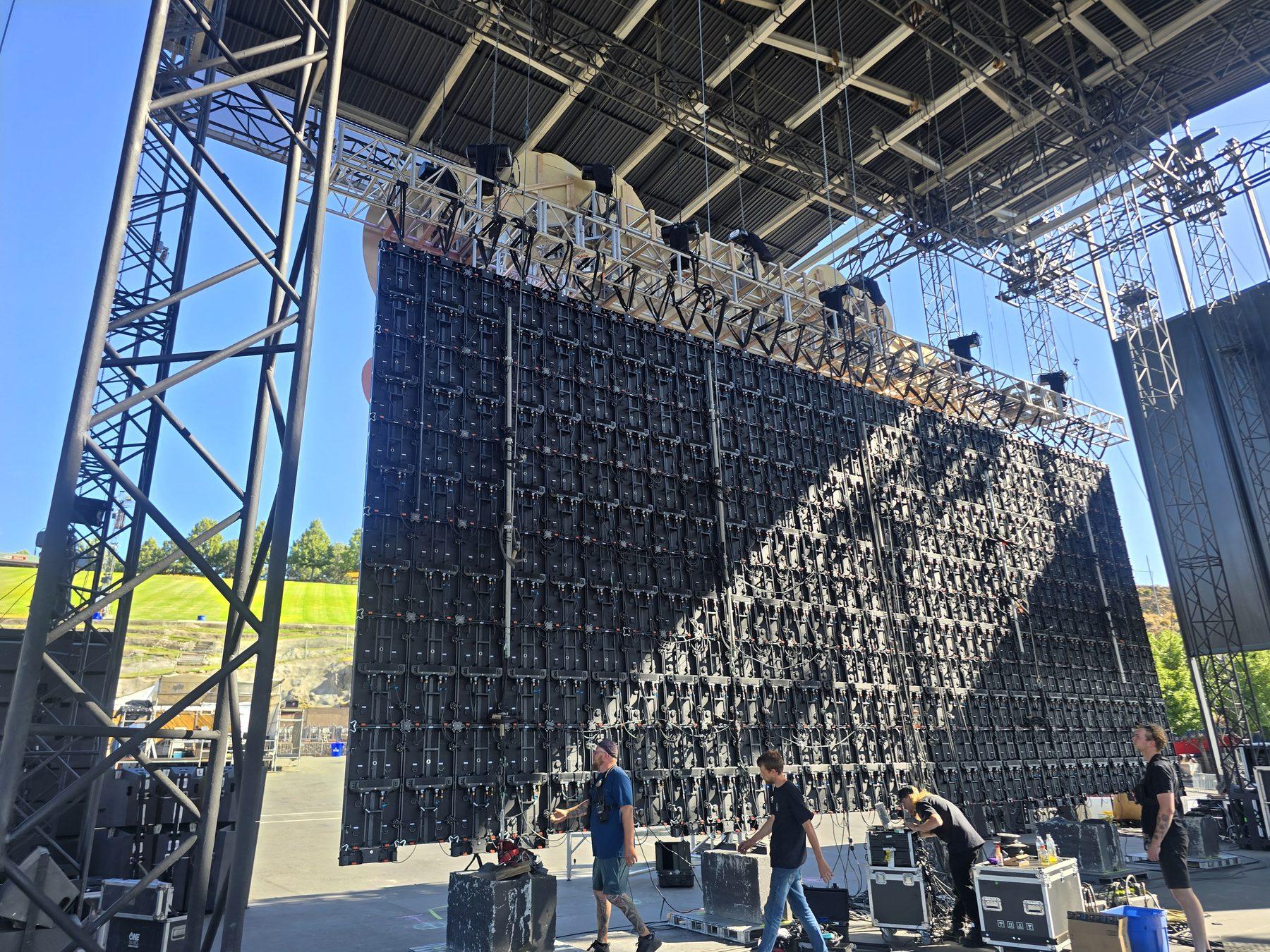
Most LED wall problems are install problems. A frame that is a few millimeters out of flat shows up as visible seams. Power that was never sized for the wall trips a breaker on the first bright scene. Data runs with no spare path turn one loose connector into a dark column. None of that is the fault of the panel, and all of it is avoidable when the people hanging the wall do it every week.
Ours do. Outside the Box is the sales side of a working production company, 4Life Entertainment, whose crews build LED walls for concerts, festivals, and corporate events, then take them down and build the next one. That crew installs the walls we sell. They survey the site before anything is ordered, set the frame, hang and align the cabinets, land power and data, and run a full pixel-map test so every cabinet is proven before content goes up.
A permanent install has work that belongs to other trades, and we say so up front. The structure the wall hangs from is the job of a licensed contractor or engineer. The circuit is the job of a licensed electrician. We give both of them the loads, drawings, and connection points they need, and we coordinate the schedule so the wall goes up once, on a finished surface.
Handoff is part of the install. Your team, or you, learn how to switch sources, set brightness, and swap a module from the front. Spare modules stay with the wall. Our support line stays open afterward, and the wall is covered by a 2-year U.S.-based warranty.
How it goes
Wall size, viewing distance, and mounting, sized on the calculator and confirmed on site.
Cabinets go on rails or a frame, leveled and locked, with structure by a licensed contractor where needed.
Power, data, processor, and a full pixel-map test before anyone sees content.
Your team learns the system at handoff, and our support line stays open after.
Questions we get
Do you install LED walls you did not sell?
Ask us. We can often install or commission a wall bought elsewhere once we have seen the cabinet type, the processor, and the mounting hardware, and we will tell you plainly if it is something we should not touch.
How long does an LED wall installation take?
A typical indoor wall is two to four days on site once the frame location and power are ready. Large walls, curved walls, and outdoor structures take longer, and we give a schedule after the survey.
What do we need to have ready before you arrive?
A wall or structure rated for the load, a dedicated circuit at the wall location, and a path for the signal from your equipment. We send the exact requirements after the survey so your contractor and electrician can prepare.
Do you handle permits and structural engineering?
Structure and permits stay with a licensed contractor or engineer. We supply weights, drawings, and attachment details for them to work from.
Can you install in a home?
Yes. Home theaters, media rooms, game rooms, and outdoor living spaces are a growing share of what we install. We work alongside the builder, designer, or integrator running the project.
What happens if a module fails later?
Modules swap from the front in minutes with a hand tool. Spares stay on site, and the 2-year U.S.-based warranty covers defects.
How much, and how soon?
Tell us how many, where it is going, and when you need it. We come back with a package price and a delivery date.